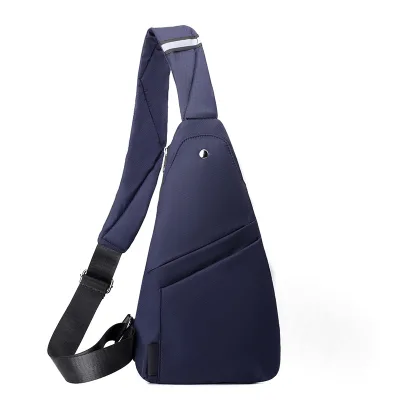
Source Waterproof Oxford Crossbody Bag for Travel, Sports, and Daily Use
Explore 30 options for a waterproof oxford crossbody bag suitable for outdoor adventures, sports, and daily commuting. Compare specifications like material, capacity, and customization services from suppliers in China to find the right fit for your business needs; compare the available evidence and request quotations based on your requirements.
Key considerations
Products List




Comprehensive Sourcing Guide
Waterproof Oxford Crossbody Bag Sourcing Guide
Sourcing a waterproof oxford crossbody bag for retail or promotional programs requires balancing fabric performance, hardware durability, and compliance obligations across a fragmented supplier base. Oxford fabric—typically polyester or nylon in a plain weave—dominates this category because it accepts polyurethane coatings and water-repellent finishes well, keeps unit weight low, and withstands abrasion from daily shoulder-carry use. Listings in this category commonly describe the inside material as polyester, position the product as waterproof, and highlight high waterproof levels and adjustable straps as selling points, which signals a market where water resistance is a baseline expectation rather than a premium differentiator.
This guide is written for buyers sourcing at wholesale volumes from Chinese manufacturing clusters such as Quanzhou, Ningbo, and Xiamen, where these bags are routinely produced under OEM/ODM arrangements with BSCI certification cited in listings. Rather than promoting any individual factory, the sections below set out how to interpret listing signals, which specifications to verify before sampling, what documentation to demand, and how to structure commercial terms and long-term quality controls so that repeat orders arrive consistent with approved samples.
Product Scope and Observed Listing Signals
Observed listings for this product type span a wide specification and commercial range. Model numbers such as QM-SL2407165, QJKSS639, OD019-20, DK23-SB08, DK20-SB092212, and TS-11271 appear alongside size statements ranging from compact dimensions like 15×6.5×23cm and 24×14×7cm to larger formats such as 3×14×8.5inch and a 19cm×8cm×36cm body. Listed MOQs range from as low as 1 unit to 3,000 units, and observed price points span roughly $1.85 to $58, reflecting a mix of small-batch stock items and fully customized production runs. Buyers should treat this spread as evidence of a two-tier market: ready-to-ship goods and made-to-order programs.
Intended-use signals in the listings include sports, camping and traveling, student, and laptop applications, with "Suitable for: Outdoor" and a natural or simplicity styling language. Unisex positioning, black or as-shown colorways, contrast-color fashion elements, and all-season usability appear repeatedly. Packing descriptions vary between polybag and carton, and customization is explicitly marked as available. These signals suggest the category serves both outdoor-leaning consumers and everyday urban users, so buyers should define their target channel first and select listings whose stated size, capacity, and styling actually match that channel rather than assuming one product fits all.
Technical Specifications to Verify
Begin verification with the fabric system itself. Confirm the oxford denier (commonly 600D or 900D in this category, but confirm rather than assume), the weave density, and whether water resistance comes from a PU coating, a durable water-repellent (DWR) finish, or laminated film. Ask how the coating is applied to the inside face, since uncoated seams and stitch holes are the usual leak paths. Request the exact composition—polyester versus nylon—affects weight, cost, and abrasion behavior. Also verify zipper type (listings cite zipper closures), water-resistance of the zipper itself, and whether storm flaps are used.
Then lock down physical dimensions and construction details against listing claims. Stated sizes such as 14.9×7.1×3.5 inches, 15×6.5×23cm, or 24×14×7cm must be confirmed with a signed measurement chart including tolerance bands. Verify strap construction: listings advertise adjustable straps, so confirm adjuster hardware material, stitching reinforcement at anchor points, and load-bearing test expectations. Confirm capacity class (medium capacity is cited), internal lining material, pocket layout, and total unit weight—observed listings cite approximately 0.350kg for one model, useful as a reference point for packaging and freight calculations.
Compliance and Safety Documentation
Documentation requirements differ by destination market, so demand paper rather than assurances. Listings in this category cite BSCI certification, which addresses social compliance and factory audit status rather than product safety; treat it as a supplier-qualification input and verify the audit scope and validity date directly. For physical product claims, ask which test reports the factory can supply for coating safety, zipper cycle life, strap strength, and colorfastness. A listing citing "CE" for one model indicates some market-facing conformity work exists in the supply chain, but CE is not a universal requirement for textile bags—confirm what the mark was actually applied to before relying on it.
Chemical compliance deserves particular attention for any bag sold into the EU, UK, or North America. Request declarations covering restricted substances relevant to coated textiles, including phthalates in PVC or PU coatings, azo dyes, and heavy metals in hardware and prints. If a supplier references OEKO-TEX-type fabric claims, ask for the certificate number and scope rather than accepting the reference at face value. Build a documentation checklist into your purchase agreement: which certificates, which test laboratories, which validity periods, and who pays for retesting when materials change between production runs.
Cost Drivers and Commercial Terms
Unit cost in this category is driven primarily by fabric denier and coating weight, zipper and hardware specification, printing or logo application method, and order quantity. The observed price band of roughly $1.85 to $58 makes sense only when separated by customization level: near the low end sit stock designs in standard colors, while higher positions reflect custom tooling, branded hardware, multi-panel construction, or upgraded water-resistance systems. MOQs from 1 to 3,000 units similarly reflect the split between trading-stock purchases and factory-direct production. Always request a costed bill of materials so you can see where money is actually spent.
Commercial terms observed in this category include FOB Xiamen pricing, T/T payment, production lead times of 45–60 days after deposit, and sample lead times of about 7–10 days. Confirm each element in writing per order: the exact Incoterms point, payment split (a deposit-balance structure is customary but confirm percentages), and whether the 45–60 day clock starts at deposit receipt or at approval of pre-production samples. Packing is listed as polybag or carton with customized packing available—price any private-label packaging separately, since inner boxes and hangtags add meaningful cost at retail-facing volumes.
Supplier Qualification and Quality Control
Qualify suppliers against evidence, not listing polish. Prioritize factories over trading companies where possible by asking for business licenses, production-floor photos or video audits, and confirmation of the cited BSCI audit status and scope. Verify that the supplier actually controls coating and cutting operations in-house or can name and audit the subcontractor who does, since water-resistance performance depends heavily on coating consistency. Ask each candidate to explain their pre-production sample process, their tolerance discipline, and how they handle material substitutions when a specified fabric or zipper becomes unavailable mid-run.
Inspect samples against a written protocol before committing. Evaluate seam sealing or taping, zipper smoothness after repeated cycling, strap anchorage under load, coating odor (a proxy for chemical quality), and dimensional accuracy versus the agreed spec. During production, structure a quality plan with defined inspection stages: incoming fabric check, inline inspection at roughly mid-production, and a final random inspection before shipment using an agreed AQL level—state the AQL you require explicitly rather than leaving it to the supplier's default. Record all results with photographs so disputes over shipped-goods quality can be resolved against documented evidence.
Long-Term Procurement Checks
Sustained programs need controls that survive staff turnover on both sides. Maintain a frozen specification file per SKU—fabric denier, coating type, zipper brand or equivalent standard, hardware finish, thread type, dimensions with tolerances, and packing drawing—and require written approval for any change. Re-benchmark costs annually against fabric market movement, and consolidate volume across fewer qualified factories to strengthen pricing and priority in the 45–60 day production queue. If you run seasonal refreshes, schedule sample development ahead of the factory's busy season so 7–10 day sample cycles remain realistic.
Finally, audit the relationship on a fixed cadence. Re-verify BSCI status and any chemical-compliance declarations each year, since certificates lapse and factory scopes change. Track field-return data by defect type—leaking seams, zipper failure, strap detachment—and feed the top defects back into the inspection plan. Confirm origin and port-of-loading details (Quanzhou and Ningbo origins with Xiamen loading appear in listings) remain consistent with your customs documentation. A supplier who accepts disciplined change control and transparent defect reporting is the one worth scaling with.
FAQs
Can I customize the waterproof oxford crossbody bag design?
Yes, customization is available for these bags. You can request specific styles, colors, and packing methods to match your brand. The supplier supports OEM and ODM services, allowing you to tailor the product to your exact requirements. This flexibility ensures the final item aligns with your market needs and aesthetic preferences.
What is the typical lead time for production?
The production lead time is typically 45 to 60 days after receiving the deposit. Sample lead time is about 7 to 10 days. This timeline allows for proper manufacturing and quality checks. Buyers should plan their inventory accordingly to ensure timely delivery for seasonal demands or specific project deadlines.
What certifications do these bags have?
These bags hold BSCI certification, indicating compliance with social responsibility standards. This certification is valuable for buyers requiring ethical sourcing verification. It assures that the manufacturing process meets specific labor and operational criteria. Buyers seeking certified suppliers for corporate or retail distribution can rely on this documented compliance for their procurement needs.
What materials are used in these crossbody bags?
The bags are primarily made from polyester and nylon materials. These fabrics provide durability and waterproof properties suitable for outdoor use. The inside material is polyester, ensuring comfort and structure. This combination offers a balance of strength and lightweight performance, ideal for daily commuting, travel, or casual outdoor activities.
What is the minimum order quantity for these bags?
The minimum order quantity ranges from 1 to 3000 units. This wide range accommodates both small trial orders and large bulk purchases. Buyers can start with a lower MOQ to test the market or scale up for significant distribution. The flexibility supports various business models, from small startups to established retailers.
Where are these bags manufactured and shipped from?
These bags originate from locations such as Quanzhou, Ningbo, and China generally. The port of loading is Xiamen, China. This geographic positioning facilitates efficient logistics and shipping routes. Buyers can expect streamlined export processes from these established manufacturing hubs, ensuring reliable supply chain management for international orders.